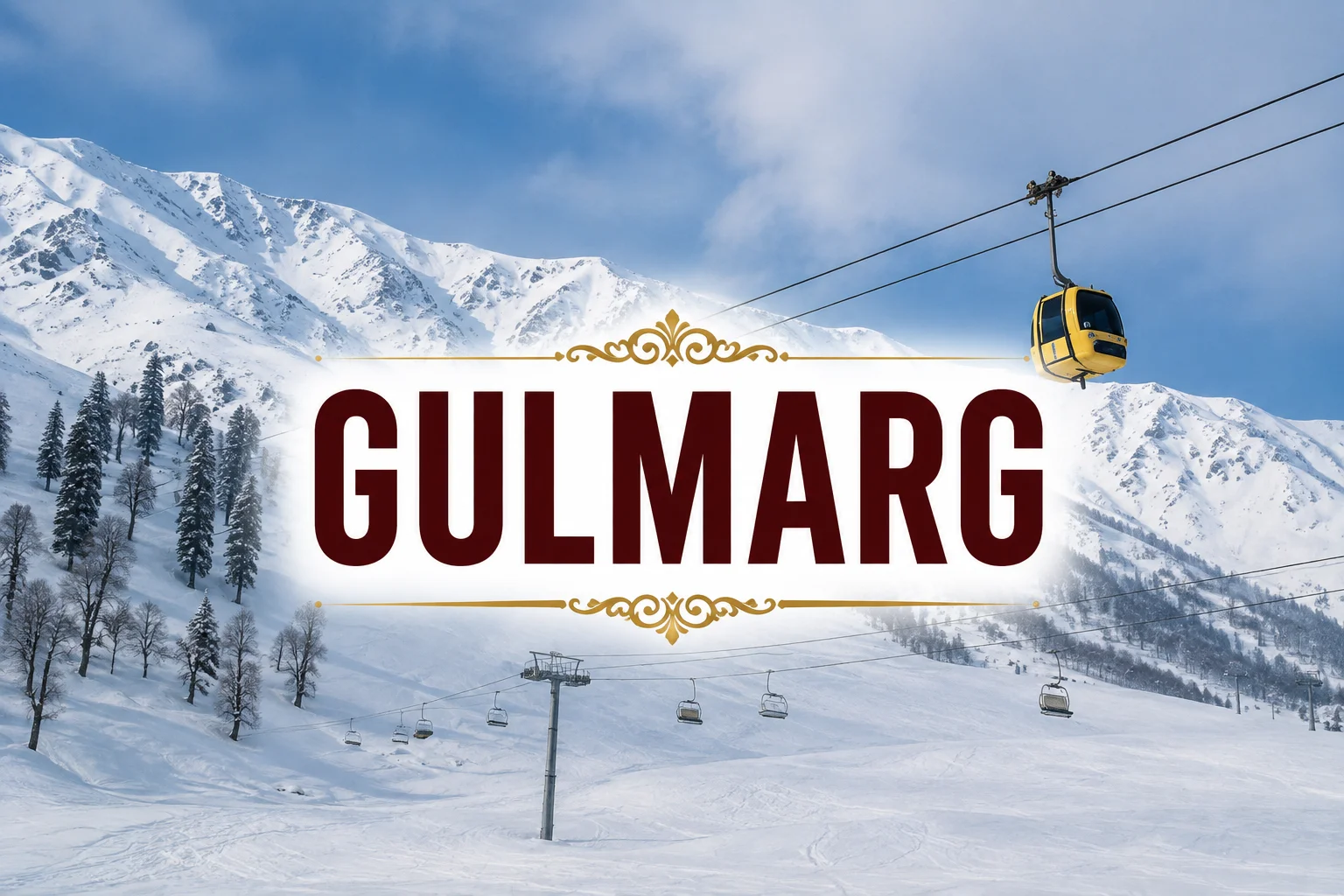
Gulmarg
- Distance from Katra~285 km
- Travel Time~8 hours by road (via Srinagar)
- Best SeasonDecember–February for snow, April–June for meadows
A meadow of flowers that turns into a snow field
The name Gulmarg means “meadow of flowers”, and from late April to June the name is literal. The wide high meadow, ringed by dark pine forest, is carpeted with yellow, white and purple blooms, and ponies graze under snow-capped peaks. Come back in January and the same meadow is buried under deep snow, the pines are heavy with white, and the place has become one of the premier ski resorts in India.
This double identity is what makes Gulmarg special. It is a place where one can walk through wildflowers in spring or glide down a slope in winter, and where an ordinary family trip can turn into an adventure by simply choosing a season. For Vaishno Devi pilgrims who extend their journey into Kashmir, Gulmarg is often the highlight, partly because it is so different from everything else on the trip.
Where it sits, and how to reach it
Gulmarg lies at about 2,650 metres in the Pir Panjal range, roughly 285 kilometres from Katra. The road journey takes around eight hours to Srinagar and then another hour or so up into the hills, making it a long haul from Katra in a single day. Almost every itinerary reaches it from a base in Srinagar instead, as a day excursion or with a night in the resort itself.
From Srinagar, the road runs to the base village of Tangmarg and then climbs steeply through forest to the meadow. It takes about an hour and a half in good conditions. In winter, snow and ice often force vehicles to use chains or local taxis, and the road can be closed temporarily after heavy snowfall. Always check conditions and be flexible.
The Gulmarg Gondola
The cable car is the main attraction. Built in two stages, it is one of the highest cable cars in the world and takes visitors from the meadow to viewpoints on the slopes of Apharwat Peak.
Phase one travels from the base station in Gulmarg to Kongdoori, a mid-station on the mountain slope, at around 3,000 metres. From here you get a wide view over the meadow and the forest, and in winter this is a ski and snow-play area. Many visitors stop here and are satisfied.
Phase two continues from Kongdoori to the upper station near Apharwat, at a height close to 4,000 metres. At the top you are above the tree line, in a world of snow, rock and thin air. On a clear day the views extend to the peaks of the Himalaya and the Karakoram, and Nanga Parbat in the distance. It is cold, windy and magnificent.
Tickets and queues
The Gondola is hugely popular, and queues can be long. Tickets are generally purchased online in advance or at the counter, with separate fares for each phase. Peak weekends, winter mornings and holiday periods sell out. Book as early as possible, arrive early in the day, and expect to wait even with a ticket.
Weather can interrupt the service. Wind, heavy snow or poor visibility can stop the cable car for hours, and your plans should allow for this. If the second phase is closed, the first is still worthwhile.
Altitude and health
At the upper station, you are close to 4,000 metres. Some visitors feel breathless, dizzy or get headaches. Move slowly, drink water, avoid exertion and descend if you feel unwell. People with heart or breathing conditions, pregnant women and very young or elderly travellers should consult a doctor beforehand. Do not spend long at the top if you feel unwell.
Winter: snow, skiing and sledding
From December to February, Gulmarg is a winter wonderland. Snow lies deep, temperatures drop well below freezing and the slopes fill with skiers, snowboarders and families playing in the snow.
For beginners, the lower slopes near the meadow are suitable for lessons. Qualified instructors teach basic skills, and rental shops supply skis, boots, poles and snowboards. Experienced skiers go higher, using the Gondola to reach the upper slopes. Off-piste skiing and heli-skiing exist but are for experts with local guides and proper safety gear. Avalanche risk is real, and visitors should never leave marked areas without professionals.
For those who do not ski, sledding, snowball fights, building snowmen and simply walking on snow are the main pleasures. Local operators pull sleds, and many families enjoy a ride for the novelty. Hot tea and noodles at roadside stalls taste better in the cold than anywhere else.
Clothing for winter
Warm, waterproof clothing is essential. The key items are thermal underwear, a fleece or wool mid-layer, a waterproof and windproof jacket, insulated waterproof trousers, snow boots, thick socks, gloves, a woollen cap, sunglasses and sunscreen. If you do not own these, you can rent jackets, boots and gloves on site. Rentals vary in quality, so inspect them before accepting, and avoid wearing jeans, which soak up water and freeze.
Keep spare gloves and socks in a dry bag. Cold, wet hands and feet are the quickest way to end a day on the snow. Carry a flask of hot tea or water.
Spring and summer: meadows, walks and golf
From April to June, the snow retreats, and the meadow turns green and then colourful. Temperatures are mild, the air is clean, and the mountains still hold snow on their upper slopes. It is a lovely time for walking, horse riding, picnics and photography.
Gulmarg also has one of the highest green golf courses in the world, laid out by British officers in the early twentieth century. Even if you do not play, the course is beautiful to walk past in summer.
Walks and treks lead to Khilanmarg, a sloping meadow with wide views, and to Alpather Lake, a high-altitude lake that can remain frozen well into summer. These involve longer walks or pony rides, and you should hire a local guide and check conditions, especially after winter.
In July and August, the monsoon brings clouds and rain, and views may vanish. Still, the greenery is lush and crowds smaller. From September to November, autumn colours appear, and the air turns cold and clear. These are quieter seasons for those who want peace.
The Maharani Temple and other quiet places
At the edge of the meadow stands the Maharani Temple, also called Mohineshwar Shivalay, a small stone Shiva temple built by a Dogra maharaja in the early twentieth century. It sits on a small hill with a view over the valley. Visitors can walk up and spend a few minutes in quiet. It is especially charming in snow.
Close by, St Mary’s Church, a stone and timber colonial building dating from the late nineteenth century, adds to the sense of history in this former British hill retreat. It is small, often closed outside services, but pleasant to see.
Ponies, taxis and getting around the meadow
Once in Gulmarg, the best ways to move are by foot, pony or local taxi. Ponies are widely available for rides to viewpoints, and the rates are usually fixed by local associations. Agree the price and route beforehand, avoid pressure to take extra stops and check the animal looks healthy. Local taxis shuttle between the base and the Gondola station, particularly in winter when roads are icy.
If you walk, wear sturdy shoes, because the meadow is uneven and wet in places. In winter, use boots with good grip, and walk carefully on packed snow.
Where to stay, and whether to overnight
Many visitors do Gulmarg as a long day trip from Srinagar. That works, but it is rushed, with a four-hour round trip by road and a limited time on the mountain. If you can, spend at least one night in Gulmarg itself. This lets you reach the Gondola early before the queues, enjoy the evening in the snow or meadow, and wake up to the mountains in the morning light.
Accommodation ranges from simple guest houses to resorts. In winter, rooms fill fast, so book ahead. Ask about heating, hot water, power backup and food. Many hotels offer meals inside, since options outside are limited. Prices rise sharply in peak season.
A day plan that works
A good winter plan starts early. Leave Srinagar at around 7:00, reach Tangmarg by 8:15 and Gulmarg by 9:00. Head straight for the Gondola before queues swell. Spend the late morning on the slopes or in the snow. Have a hot lunch at a restaurant in the meadow around 1:00. Try a pony ride or a walk to the Maharani Temple in the afternoon. Begin the descent by 3:30 to be back in Srinagar by dark.
In summer, the plan is similar, but you can walk longer, and the Gondola queue is often shorter. Take advantage of the long light for a leisurely day.
Families, children and older parents
Gulmarg is enjoyable for all ages if you plan realistically. Children love the snow and the ponies, but they tire and chill quickly. Dress them in more layers than seems necessary, bring spare gloves and socks, and take frequent breaks indoors with hot drinks. Do not let them wander near lifts, slopes or deep drifts. Sledding with an adult is a safe way to give them a thrill.
For older parents, the main concerns are cold, altitude and walking on slippery ground. The first stage of the Gondola reaches around 3,000 metres, which most healthy elders handle comfortably, though those with heart or lung conditions should check with a doctor. Walking on snow and ice is tiring and risky, so let them stay in the warm with a view while others go out. A pony or sled can carry them to a viewpoint. Hot soup and a window seat are the best gifts you can give to someone who cannot walk far.
If anyone is nervous about heights, the Gondola can be unnerving. The cabins are enclosed and stable, but the drop below is substantial. Sit near the centre, look at the horizon and take slow breaths. For some travellers, simply visiting the meadow and the temple, without taking the Gondola, is enough.
Photography and light
Gulmarg is one of the most photogenic places in Kashmir. In winter, early morning light on fresh snow is crisp and blue, and late afternoon turns the peaks pink. Bright snow can confuse a camera’s metering, so you may need to brighten your picture. Protect your phone and camera from moisture, and keep spare batteries warm in an inside pocket. In summer, wildflowers photograph best in soft morning or evening light, with pines and peaks as backdrops. Ponies, wooden huts and the Maharani Temple add character to compositions.
Be respectful when photographing locals, especially women and children. Ask before taking portraits, and offer to share the picture. Avoid flying drones, which are restricted in many parts of Kashmir and can cause problems with the authorities.
Fitting Gulmarg into a Kashmir week
Most travellers who include Gulmarg are on a longer Kashmir journey. A common pattern is to travel from Katra to Srinagar on day one, spend day two on Dal Lake and the Mughal gardens, use day three for Gulmarg, and day four for Sonmarg or Pahalgam before heading back. This gives a balanced mix of lake, garden, snow or meadow, and valley scenery, and allows rest between long drives.
If you have only one extra day, pick Gulmarg in winter and the gardens or lake in spring and summer. If you have two days, Gulmarg plus Srinagar is a perfect pair. If you have a week, add Pahalgam and Sonmarg and enjoy the valley at a slower pace. See our pages on Srinagar, Sonmarg and Pahalgam to compare.
Food and drink
Restaurants in Gulmarg serve Kashmiri, north Indian and Chinese dishes, with vegetarian options such as rajma, dal, paneer and noodles. Hot tea, kahwa and soup are popular in the cold. Prices are higher than in Srinagar, so budget accordingly. If you have dietary needs, carry some snacks, particularly for children.
Safety first
Mountain conditions change quickly. Respect closures and warnings, and follow the instructions of lift operators and ski patrol. Avoid off-piste areas without a guide. Keep children close, especially around lifts and slopes. Protect your skin and eyes from sun and glare at altitude, even on cloudy days.
Conditions on the Kashmir routes change quickly. Before you book, check the current J&K travel advisories and highway status, because heavy rain or snow can close the road for hours. Leave a spare day in your plan rather than a tight connection home.
Tips Before You Go
- Book gondola tickets ahead where you can. Peak weekends and winter mornings sell out.
- Carry warm layers even in summer, because it is much colder at the top.
- Winter gear such as jackets and boots can be rented on site if you do not own any.
- Snow is the draw from December to February, and green meadows and flowers from April to June.
- Conditions on the Kashmir routes change quickly. Before you book, check the current J&K travel advisories and highway status, because heavy rain or snow can close the road for hours. Leave a spare day in your plan rather than a tight connection home.
- Start early, since the queue builds by mid-morning and weather turns in the afternoon.
- Carry cash and a power bank, since cold drains phone batteries quickly.
Pairs Well With
Add This to Your Yatra
Gulmarg is one of the multi-day Kashmir attractions in our wizard. Add it alongside Srinagar and we’ll build out the extra travel days in your itinerary.
Want Gulmarg in your itinerary?
Add to My Yatra