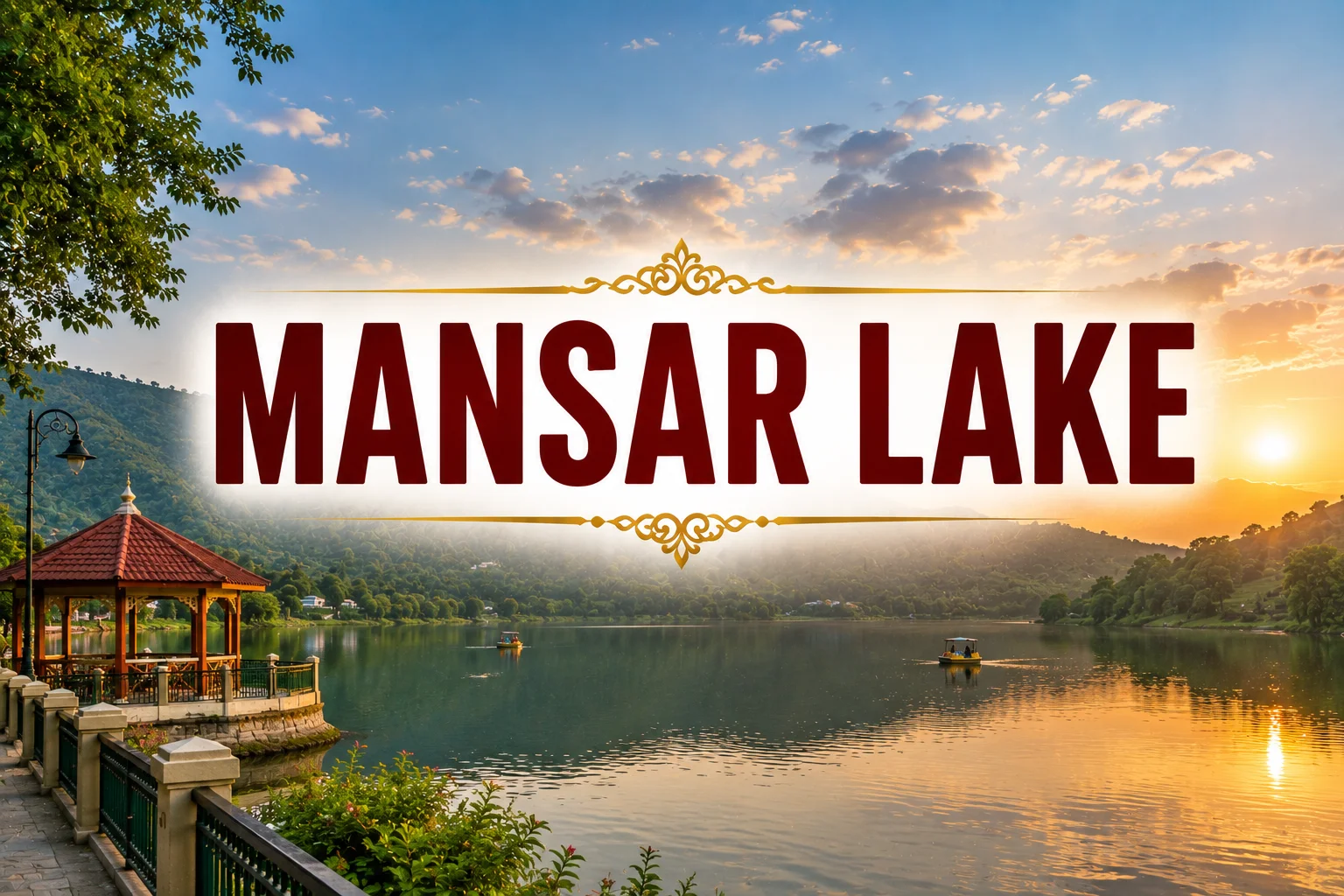
Mansar Lake
- Distance from Katra~75 km
- Travel Time~1.5–2 hours by road
- Best SeasonOctober to March
Why people stop here at all
Most visitors who come to this part of the country arrive with a single purpose, and they plan every hour around the climb to the cave shrine. That is how it should be. But the days around the yatra often contain gaps: a free afternoon after you arrive in Jammu, a slow morning before a late flight, a day your parents want to spend resting while the younger members of the family have energy left over. Mansar Lake is one of the best answers to that gap. It is calm, green, easy to reach and gentle on the legs, and it offers something the rest of the trip does not: water, open sky and the feeling of being on holiday instead of on a mission.
The lake is a natural freshwater body ringed by wooded hills, roughly 60 to 65 kilometres from Jammu city on the road toward Pathankot and Punjab. It is not a dramatic place. There is no famous skyline, no grand fort, no celebrated view. Its appeal lies in how ordinary and pleasant a day there is, and in the fact that for the people of Jammu region it is a place of real sentiment, visited for weddings, picnics, family rituals and quiet evenings.
The lake and its sacred reputation
The name is generally linked to Manasarovar, the great lake of Himalayan lore, and many locals regard Mansar as a smaller sibling of that sacred water. You will hear a number of stories about the lake. One ties it to the Mahabharata and the serpent king Sheshnag. Another associates the area with Arjuna and his wife Ulupi. These are traditions rather than documented history, and you should treat them as the cultural background of the place, not as facts to be argued over. What matters is that the lake is treated with respect by the people who live near it.
The best-known custom is that newly married couples walk once around the lake as a blessing for their marriage. On a weekend in the wedding season you may see brides in red and grooms in turbans completing the circuit, often with relatives and photographers in tow. A small temple stands on the bank, and nearby there are shrines associated with Lord Shiva and with Narasimha. The faith of the surrounding villages is part of the atmosphere, and it is why the lake feels more like a community space than a tourist attraction.
The twin lakes and the sanctuary
Mansar does not stand alone. Surinsar, a similar lake, lies about two dozen kilometres away, and together the two are often described as twin lakes. The area between them is protected as a wildlife sanctuary, and it is home to deer, nilgai and a range of birds. You will not be on a safari, and you should not expect to spot dramatic animals from the lakeside path. But early in the morning or near sunset, the shore can be a quiet place to watch birds, and the forest edge sometimes shows deer grazing within sight of the road.
If you enjoy birdwatching or photography, bring a zoom lens or binoculars and go early. If you only want a gentle walk, the sanctuary adds a layer of pleasantness to the setting without demanding any effort from you.
A day at the lake, in three acts
A good visit here is unhurried, so we suggest a rhythm instead of an itinerary.
The arrival. Leave Jammu or Katra after breakfast and plan to reach the lake by late morning. The road runs through the Jammu plains and then rises gently into low forested hills. When you arrive, do not rush to buy a boat ticket. Walk first. The path along the shore is easy and shaded in places, and it is the best way to understand the shape of the lake and to find a spot you like.
The middle of the day. This is the time for the boat. Pedal boats and rowing boats are generally available near the entrance, and a short ride takes you onto the water and away from the noise of the shore. Children love this part. Older relatives who cannot manage a long walk can sit in a boat and enjoy the view just as much as anyone. After the boat, find lunch at one of the small eateries near the entrance. The food is simple and vegetarian-friendly, and it is best to keep expectations modest.
The afternoon. After lunch, visit the temples on the bank, sit for a while, and let the heat of the day pass. If you have energy, walk around the lake in the direction local tradition prefers, keeping the water on your right as you circle it, and take your time. If you are travelling with children, they may be happy to spend the late afternoon on the playground and amusement area that often forms part of the visit. Leave by mid or late afternoon so you are not on the road at night.
Who this trip suits, and who should skip it
Mansar Lake is a good fit for families with young children, who benefit from open space and water; for older travellers who cannot manage steep climbs but want a pleasant outing; for groups who have already done the shrine and want a restful day; and for photographers and birdwatchers who enjoy a still landscape.
It is less suited to people expecting a famous attraction, or to those with very limited time who want to maximise sightseeing. If you only have a single spare afternoon in Jammu, the temples and bazaars of the old city give you more cultural content per hour. Mansar rewards the traveller who is willing to slow down.
Getting there and moving around
The lake is around 75 kilometres from Katra, about an hour and a half to two hours by road, and the route runs back through Jammu. Hiring a cab for the day is the easiest option, and your driver can wait while you walk and eat. If you are already in Jammu, the drive from the city is shorter. Public buses reach the area, but they are less convenient for a day trip with luggage or elders.
If you are arriving in Jammu by air or rail and your hotel in Katra is booked for the evening, you can break the journey at the lake, stop for a couple of hours and continue on. This requires some care with luggage and timing, so agree the plan with your driver in advance.
When to go, season by season
October to March is the best period, with clear skies, mild days and cool evenings. The light in winter is soft and attractive for photography, and the walk around the lake is comfortable. In October and early November you may also catch a little of the post-monsoon green.
April to June is hot in the plains, and the open shoreline offers little shade at midday. If you must visit then, go very early or late in the afternoon. July to September brings the monsoon, which fills the lake and makes the hills lush, but also brings humidity, rain and occasionally interrupted roads. A monsoon visit can be beautiful, but plan for flexibility.
What to eat, and what to carry
The food around the lake is limited compared with Jammu city, so it is sensible to carry a few items yourself. Fruit, biscuits, nuts and a large bottle of water are enough for most families. If you are travelling with small children, a spare set of clothes is useful, since the water, the boats and the playground often lead to wet shoes and muddy knees.
Remember that you are still in the region where meat and alcohol are not served around pilgrim sites, and most small eateries near the lake serve vegetarian snacks such as samosas, pakoras, tea and simple meals. Jammu’s famous rajma-chawal is worth seeking out if you are returning through the city.
Things worth knowing before you go
- Boating hours and prices change by season, and some boats close during very cold or very wet weather. Confirm on arrival, and do not assume a boat is always available.
- Weekends fill with local families, especially in the wedding season and on holidays. A weekday is calmer.
- Footwear matters. The shore can be muddy after rain, and flip-flops are not ideal for a long walk.
- Respect the religious character of the place. Dress modestly near the temples, and avoid loud music or littering.
- There are limited toilets and changing facilities. Plan around this, particularly if you are travelling with elderly relatives or small children.
- Mobile signal is usually available but can be patchy in the hills. Download any maps or tickets before you leave.
Making a longer day of it
If you have a full day and want to add something, the most natural pairing is a morning in Jammu city before you head to the lake, or an evening back in the city bazaars. A morning at the Raghunath Temple complex followed by an afternoon at the lake gives a day that blends culture and nature, and it sits comfortably within a trip that is otherwise devoted to the shrine.
Another option is to treat Mansar as the final stop on a travel day toward Punjab. If you are going on to Amritsar after the yatra, the road passes close to the lake region, and a lunch stop there turns the drive into something more pleasant than a transfer.
Travelling with children, elders and people with limited mobility
Families often ask whether a place like this is practical for everyone in the group, and in general the answer is yes. The terrain around the lake is flat, the main path is short, and there is no steep climb. A child who has walked part of the yatra will usually have plenty of energy left for the shore, and a grandparent who rode a pony up the mountain can sit comfortably on a bench or in a boat.
For small children, hold hands near the water. The banks are not fenced for long stretches, and the shoreline can be slippery. Life jackets are normally provided on boats, but check that they fit properly before you set off, and do not allow children to stand up in a pedal boat. For older relatives, the main considerations are toilets, shade and seating. Take a light folding stool or ask your driver where the nearest benches are, and plan breaks every twenty minutes or so. If someone in the group uses a wheelchair, tell your driver in advance, as access to the water’s edge can be uneven and you may need help over a few steps.
It is also worth carrying a small first-aid kit with plasters, antiseptic wipes and any regular medicines. Pharmacies are far from the lake, and the nearest hospital is in Jammu or at the district level.
A note on pace and expectations
Travellers sometimes arrive at a place like this with the wrong expectations, hoping for a spectacle, and leave disappointed. Mansar is not a spectacle. It is a place to sit, to walk slowly, to watch light on water and to let your mind unwind after the effort of the climb. If you treat it that way, it is one of the most restful hours of the whole trip. If you are in a hurry, skip it and save your energy for somewhere that rewards speed.
Tips Before You Go
- Go on a weekday if you can. Weekends fill up with local families.
- The lake is best in cooler months. Summer afternoons on the open shore are hot.
- Bring water, sun protection and a hat.
- Boats and the nearby park run to their own seasonal timings, so confirm on arrival.
- Keep an hour in hand for the return, since traffic near Jammu can slow the evening drive.
Pairs Well With
- Jammu Sightseeing, since the route passes back through the city.
- Patnitop if you want a hill-station day on another trip.
- Baba Dhansar for a quiet shrine visit on a separate half-day.
Add This to Your Yatra
Add Mansar Lake as a zero-extra-day, en-route stop in the wizard. It’s designed to fit into your existing Jammu-side travel day without needing an extra night.
Want Mansar Lake in your itinerary?
Add to My Yatra