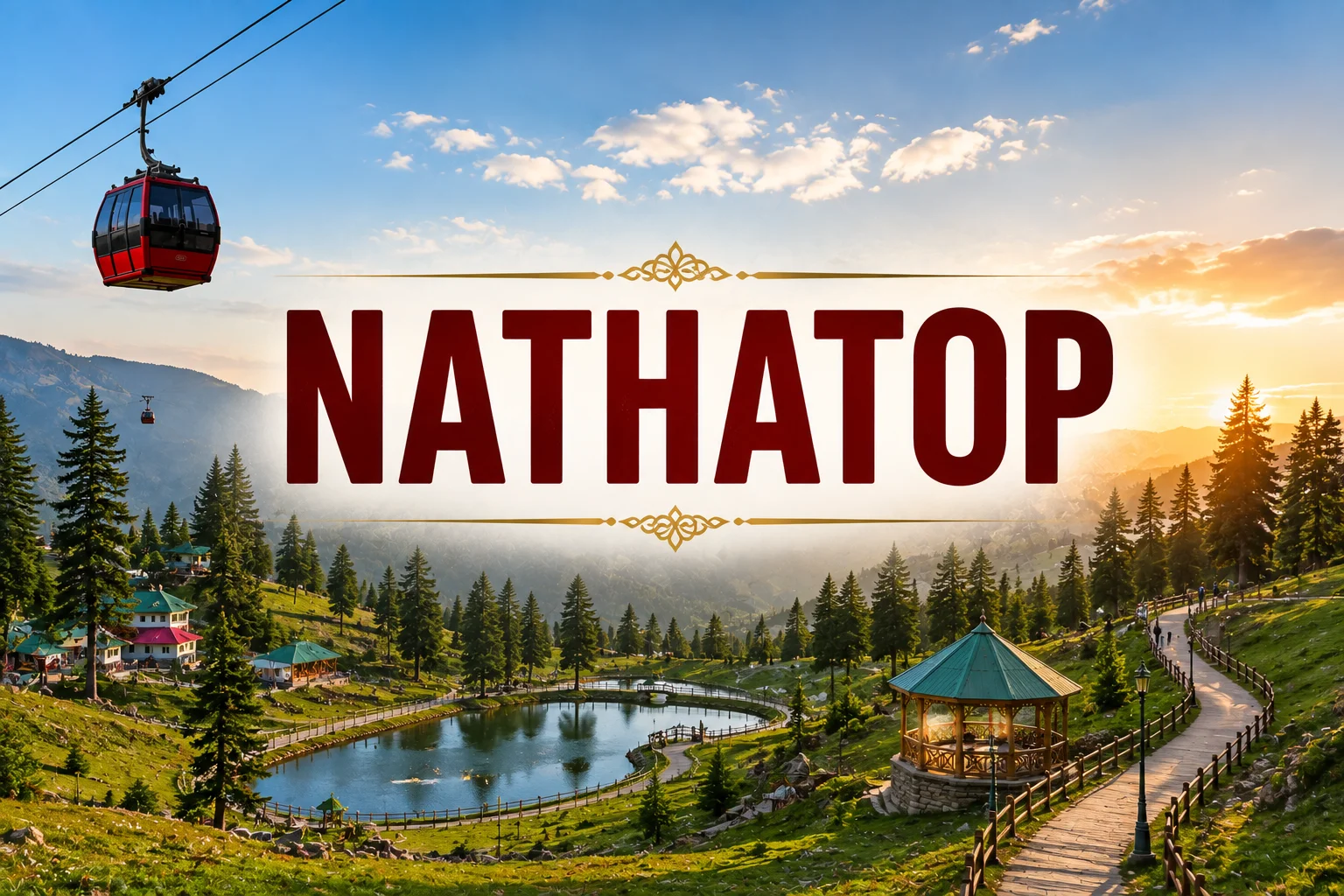
Nathatop
- Distance from Katra~93 km
- Travel Time~2.5 hours by road
- Best SeasonMay–June for views, December–February for snow
The higher, quieter neighbour
If Patnitop is the comfortable resort on the plateau, Nathatop is the wilder cousin a little higher up the hill. It sits at about 2,100 metres, a short climb above Patnitop, and the difference in altitude, though only a hundred metres or so, is enough to change the character of the place. It is cooler, windier and often snowier. The infrastructure is thinner, the crowds smaller and the sense of being at the top of something is stronger.
People tend to arrive here after an hour or two at Patnitop, and they often say the same thing: they had not expected to be so struck by a place that looked from below like an ordinary ridge. The reason is the view. From the open slopes of Nathatop, ridgelines fall away in layers toward the valley, pine forests turn blue in the distance, and on a clear day you can see far across the range. It is a place for standing still and looking.
The drive up, from the highway
Nathatop is about 93 kilometres from Katra, roughly two and a half hours by road, and it is reached by continuing past Patnitop on the Jammu to Srinagar highway and then taking a short diversion up the hill. The sequence of the drive is part of the experience.
You leave Katra and join the main highway, passing through Udhampur and into the folded hills of the Shiwalik range. The road narrows and climbs through pine forests, with sudden gaps that show the valley opening beneath you. Villages cling to terraced slopes. The air cools noticeably as you gain height, and in winter you will see snow lying in shaded patches long before you reach the top.
After Patnitop, the diversion climbs more steeply, and the road can be narrow and rough in places. Drivers who know the route take it slowly, and you should let them. In snow season, the climb may be closed or restricted, and local drivers will tell you whether you can proceed. If there is any doubt, trust their judgement and enjoy Patnitop instead.
What to do at the top
Nathatop is an unhurried place, and most of what you do there is walk and watch. There are open meadows where you can wander, small viewpoints where people pause for photographs, and trails through the surrounding forest. In winter, snow makes the slopes popular for sledging and snow play, and short winter treks are a favourite with adventurous visitors.
Facilities are modest. You will find a few stalls selling tea, snacks and Maggi noodles, and some seasonal operators offering rides or activities. Do not count on a full restaurant, and do not assume every stall will be open in the off-season.
For photographers, the best moments are early morning, when light is soft and the valley is often filled with mist, and late afternoon, when long shadows fall across the slopes and the ridgelines glow. A wide-angle lens captures the layered hills, while a zoom picks out distant villages and the lines of terraced fields.
Photography: getting a good result
Because the main appeal is the view, a few notes will help you make the most of it.
Arrive early if you can. By midday, haze can soften the distance, particularly in summer. Clear days after rain give the sharpest views. In winter, bright snow can fool the camera’s exposure and make the picture look grey, so brighten it slightly if you can. Keep spare batteries warm in an inside pocket, since cold drains them fast. Protect lenses from condensation by letting the camera adjust to temperature changes slowly.
If you are using a phone, wipe the lens often, hold it steady and tap on the part of the scene you want properly exposed. Include foreground elements such as pine branches or grass to give depth. And do not spend the entire visit looking through a screen. The place rewards a few quiet minutes with your own eyes.
Season by season
December to February. Snow is the main draw. Nathatop often has cover before and longer than Patnitop, making it an attractive choice for visitors who want deeper snow. It is also the most challenging time. Roads can close after heavy snowfall, temperatures fall well below freezing at night and daylight is short. Wear waterproof boots, gloves, a woollen cap and several layers. Plan to be back at lower altitude before dark.
March and April. The snow gradually retreats, and the first green appears. It is a good time for quiet, cool walks.
May and June. These months give some of the best long-range views of the year. Skies are usually clear, the air is pleasant and the meadows are green. It is also busy at Patnitop below. A lot of visitors skip Nathatop, so the top is calmer.
July to September. The monsoon brings cloud, fog and rain. Views can disappear entirely, and the road may be slippery. This is the worst time for a view-based visit, so time it carefully or choose another season.
October and November. Crisp, clear and quiet. The light is excellent, and the cold begins to bite in the evenings.
Doing Nathatop and Patnitop together
Because the two places are so close, almost everyone treats them as a single excursion. A good plan starts early. Leave Katra around seven, reach Patnitop by mid-morning and spend an hour or two there. Then continue to Nathatop for the late-morning or early-afternoon light, have a simple lunch or snack, and start back by three. This avoids driving after dark and gives you a gentle, varied day.
If you want to see Nathatop in the best light and avoid crowds, reverse the order. Go to Nathatop first, while the morning is fresh, then come down to Patnitop for lunch and a leisurely afternoon. The only complication is that some of the services at Patnitop run to a schedule, so check what you want to do before deciding.
Staying overnight
Overnight stays near Nathatop itself are limited, and most people stay at Patnitop or in nearby villages. If you want to see the sunrise from the top, ask your hotel about early transfers, and be prepared for cold. A night at Patnitop gives you time to enjoy both places without the long drive back.
Safety in snow and cold
Winter conditions deserve respect. Roads can be icy, and cars without chains may slip. Local drivers are experienced and often carry chains, so use them. Do not drive yourself unless you are confident in snow. If the road is closed, accept it and do not argue with the police or local authorities, who will have good reasons.
Cold exposure is the main risk to health. Layers, a windproof outer shell, insulated gloves, thick socks and a warm cap are essential. Carry a flask of hot tea. Keep children’s hands and feet dry. Avoid alcohol, which gives a false sense of warmth. If anyone is shivering uncontrollably, confused or has numb fingers, move them to shelter and warm them gradually.
Altitude is modest, so altitude sickness is unlikely, but people with heart or lung conditions should take it easy and carry their medicines.
What to pack for a day at 2,100 metres
A short checklist is worth more than a long essay. For a day at Nathatop, carry:
- A windproof jacket or shell, even in summer. The ridge is exposed and wind chill can surprise you.
- A fleece or sweater to wear underneath, and a thermal layer in winter.
- Waterproof shoes or boots with grip. Wet grass and melting snow make light shoes miserable.
- Gloves, a woollen cap and a scarf from November to March.
- Sunglasses and sunscreen. Altitude and snow reflection can burn skin and eyes quickly.
- A flask of hot tea, snacks, water and tissues.
- A small bag for rubbish, because there are few bins.
- Your phone, a power bank kept warm, and a printed note of your driver’s number.
A timed day, from Katra and back
A realistic schedule makes planning easier. Leave Katra at 6:45 in the morning. By 8:15 you are passing Udhampur, and by 9:30 you reach Patnitop, where you stop for tea and a short walk. At 10:30 you begin the climb toward Nathatop and arrive by 11:15. Spend until about 1:00 walking and photographing, with a snack at one of the stalls. Descend to Patnitop for a proper lunch around 1:30 and start back at 3:00. You reach Katra between 5:30 and 6:00, in time for dinner and an early night.
In winter, move everything an hour earlier, and be ready to cancel the upper part if the road is closed. In monsoon, expect fog and treat the day as a drive and a walk, not a view.
Reading the landscape you are looking at
Part of what makes Nathatop satisfying is understanding what lies below you. The hills that fall away on every side are part of the Pir Panjal and Shiwalik systems, and the deep valley beneath is carved by the Chenab river, one of the great rivers of the region. The terraced fields you see are tended by families who have farmed these slopes for generations, growing maize, wheat and vegetables in a short season. The highway that threads through the hills is the main road link between Jammu and the Kashmir valley, and it has been the lifeline of this region for decades.
Look for the changes in vegetation as you climb. Lower slopes carry broadleaf trees and scrub, middle slopes turn to chir pine, and higher up come deodar and fir. At the top you may see meadows grazed by sheep and goats belonging to seasonal herders. In summer, families of Gujjar and Bakarwal herders move their flocks up from the plains, a tradition of seasonal migration that has shaped this landscape for centuries. If you meet them, greet them politely, ask before photographing and do not feed the animals.
Visiting responsibly
High mountain meadows are fragile. Stay on existing paths, do not pick flowers, and take every piece of rubbish with you, including food wrappers and bottles. Avoid loud music, which disturbs both wildlife and other visitors. If you light a fire, which you should only do where it is permitted, put it out fully. And buy tea, snacks and souvenirs from local stall-holders, whose seasonal income depends on visitors like you.
Nearby options if Nathatop is closed
Occasionally the road to Nathatop is closed because of snow, landslides or maintenance. Do not let that spoil the day. The meadow at Patnitop, the Naag Temple, the viewpoints along the highway and the small plateau at Sanasar all offer gentle alternatives. Your driver will know which are open. Having a backup in mind keeps a disappointment from turning into a wasted day.
Who it suits
Nathatop suits travellers who value views over facilities, who enjoy quiet, who like photography and who are happy with simple food. It is a good choice for couples, small groups of friends and families with older children. It is less suitable for people who want entertainment, restaurants or shopping, or those with limited mobility who cannot manage short uneven walks.
If you are travelling with very young children or frail elders, you may prefer to stay at Patnitop, where the ground is flatter and the facilities better, and let the more energetic family members make the short trip up.
Tips Before You Go
- The two places are close together. Nathatop sits higher, so it is colder and windier.
- In winter the road can be affected by snow, so check with your driver before setting out.
- Bring a jacket even in May and June, since the evenings cool fast.
- Food options are limited. Carry snacks and water.
- Use the toilet in Patnitop before you go up.
- Start the return by mid-afternoon so you are off the mountain road before dark.
Pairs Well With
- Patnitop, which is bundled with it in our packages.
- Shiv Khori on a different day if you have extra time.
- Jammu Sightseeing for a cultural day back in the city.
Add This to Your Yatra
Nathatop is bundled with Patnitop as one combined day-excursion in our wizard. Select it once and both stops are included in your itinerary and price.
Want Nathatop in your itinerary?
Add to My Yatra