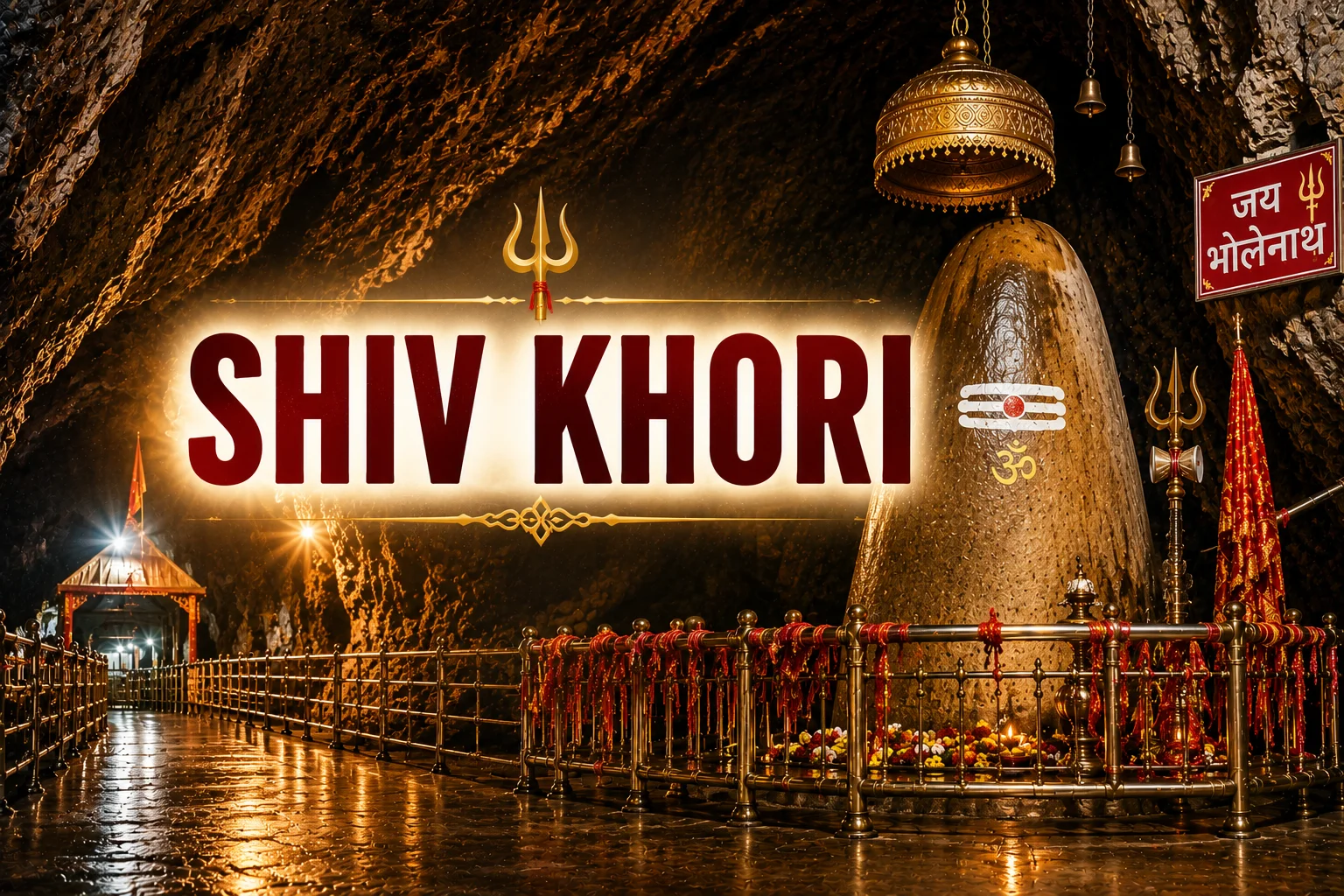
Shiv Khori
- Distance from Katra~75 km
- Travel Time~2 hours by road
- Best SeasonOctober to March (cooler for the cave walk)
A cave you walk into, not a temple you visit
Most shrines are buildings. You arrive, remove your shoes, queue, see the deity and leave. Shiv Khori is something different. It is a natural limestone cave, formed by water and time, in which the shrine is the cave itself. You do not simply look at the sacred object. You walk into the mountain to reach it, feeling the rock close in around you and the air change, and when you finally stand before the Shivling you have earned the moment.
For this reason, many pilgrims remember Shiv Khori more vividly than they expected to. It sits in the foothills of the Trikuta range near the village of Ransoo in Reasi district, about 75 kilometres from Katra, and it is one of the most visited Shiva shrines in the region. It is also a good counterpart to Vaishno Devi. One is a cave to the Mother Goddess, climbed after a long walk. The other is a cave to Lord Shiva, reached after a shorter walk and a narrow passage. For devotees, visiting both feels like a complete circle.
The legend that links the two shrines
The traditional story ties Shiv Khori to the Vaishno Devi tradition. According to local belief, when the demon Bhasmasur received a boon from Shiva that anyone he touched on the head would burn to ashes, he tried to use it on Shiva himself. Shiva fled and took refuge in this cave, and Vishnu in the form of the enchantress Mohini lured Bhasmasur into dancing and destroying himself. Pilgrims believe that Shiva waited in the cave while the danger passed, and that the cave itself is his dwelling.
A second tradition links the cave with the mythology of Vaishno Devi. The story goes that when the goddess was pursued by Bhairon Nath, a passage in the Shiv Khori cave is said to connect with the Vaishno Devi cave, and that devotees believe this is part of why the two shrines belong together. These are matters of faith and not of documented history. We mention them because they shape how local people understand the place and why so many yatris treat it as a natural extension of their trip.
What the cave is like inside
The entrance is a narrow opening in the rock face, and from there a passage runs inward for roughly 200 metres. Visitors walk in single file or in small groups, usually moving slowly because of the queue and the narrowness. In some places the ceiling is low enough that you must stoop. In others the cave widens into small chambers where you can stand upright and look around.
The walls and ceiling are hung with stalactites and rock formations that devotees associate with sacred figures. Guides and fellow pilgrims will point out shapes that resemble the hooded serpent Sheshnag, a cow’s udder from which water drips, the trident of Shiva, the form of the goddess and others. You do not have to see them in order to appreciate the cave, but the sense of shared recognition adds a ceremonial quality to the walk.
The air is cool and often humid. Even on a hot day, the cave interior feels refreshing, and in winter it can feel warmer than outside. Floors are damp, and the rock can be slippery. At the far end, you reach the inner sanctum, where the self-formed Shivling stands, believed by devotees to be growing slowly over time. Devotees offer milk, flowers and water, and the priests guide the queue so that everyone can have a few moments in front of the Shivling.
The approach: from the road to the cave mouth
You do not drive directly to the cave. The road ends at a base village, from which you walk about 1.5 kilometres along a paved path to the cave mouth. The walk is gentle on most stretches, with a few slopes. Stalls line the route, selling offerings, snacks and souvenirs. For those who find the walk difficult, ponies and palanquins are usually available. Agree the price before setting off.
You pass through security checks before you enter the shrine area. Mobile phones, cameras and bags are often not allowed in the cave, so be prepared to leave them in your vehicle or in a locker. Keep valuables to a minimum, and let one member of the group stay outside with the bags if needed.
The queue, and how to handle it
On a quiet weekday, there may be little or no queue and the whole visit, from arrival to departure, takes an hour or two. On weekends, festivals and in peak pilgrim season, you can wait for several hours before entering the cave. Mahashivratri is the busiest day of the year, with huge crowds and a fair-like atmosphere.
If you are going on a busy day, be prepared. Wear comfortable clothes, carry water, and keep children close. Arrive early, ideally before nine in the morning, so that you are in the queue before the midday rush. Be patient, since the passage is narrow and the pace is slow. If you are travelling with elders, consider whether they can manage standing for a long time. If not, choose a quieter day.
Is it safe if I am nervous about narrow spaces?
Honest answer: the passage does narrow in places, and some visitors find it uncomfortable. If you have claustrophobia, think carefully. The cave is not long, and it is well-trafficked, with people ahead and behind you, so you are rarely alone. But the combination of low ceilings, damp rock and crowds can be stressful. If you feel anxious, tell someone, breathe slowly and step aside for a moment where there is room.
People with significant mobility limitations, severe heart or breathing problems, or recent surgery should consult a doctor before going. The cave is not designed for wheelchairs, and the surface is uneven. If a member of the group cannot enter, others can go in turns, while someone waits outside.
A day, from Katra and back
Plan most of a day. A realistic schedule looks like this. Leave Katra at seven in the morning, so that you reach the base village by nine or half past. The road winds through Reasi town and across hill country, and it takes about two hours. Walk to the cave, join the queue, and expect the visit to take one to three hours depending on the crowd. After darshan, eat at the langar near the base or at a small restaurant. Start back by one or two in the afternoon, and you will reach Katra by late afternoon.
Because the drive is long and the road can be tiring, travel sickness is common. Carry tablets if you are prone to it, and sit near the front of the vehicle. Take breaks, and have a light breakfast before leaving.
Langar and food
A community kitchen typically runs near the base, operated by the shrine trust, serving free meals to all pilgrims. The food is simple vegetarian fare, usually dal, rice, roti and vegetables, and it is a pleasant way to finish the visit. If you accept a meal, you can leave a small donation. Shops and stalls near the base also sell tea, snacks and packaged food. Carrying your own water and snacks is a good idea.
Choosing the right season
The shrine is open through the year, and the cave interior stays naturally cool regardless of the outside temperature. The difference is in the approach and the queue.
- October to March is the best period. Days are mild, the walk is easy and queues are comfortable. December and January can be cold in the morning, so carry a warm layer.
- April to June brings heat. The road and the walk can be tiring, and queues form on school holidays. Start early and drink plenty of water.
- July to September is the monsoon. Rain can make roads slippery, and landslides sometimes disrupt access. Check conditions before travelling, and expect delays.
- Mahashivratri (usually February or March) is the biggest day. Go if you want the festive atmosphere and are ready for huge crowds. Avoid it if you want a quiet visit.
Etiquette inside the shrine
Dress modestly and remove your shoes before entering. Move steadily and in order, without pushing. Photography is usually restricted inside the sanctum, so follow the rules and instructions of the priests. Do not touch the rock formations unnecessarily, since oils and moisture from hands can damage them over time. If you carry offerings, follow the lead of the priest on what to do with them. Keep your voice low, because the cave carries sound and the atmosphere is solemn.
Taking children and older parents
Shiv Khori is manageable for most families, but the details matter. Children over about six usually enjoy the cave, which feels like an adventure, with its dripping ceilings, strange shapes and cool air. Younger children may be frightened by the dim light and the press of people, so hold their hands, speak calmly and explain what they will see before you go in. Carry them if the queue is slow and the passage is damp.
For older parents, the key questions are the walk, the standing and the passage. The approach path is gentle, and ponies or palanquins can help. Standing in a long queue is harder, so choose a quiet day, take a folding stool or ask staff where seating is available. The passage itself is the main challenge. If a parent has difficulty with stooping, with steps or with narrow spaces, discuss with them honestly beforehand. Many elders go in with a younger family member holding an arm. Others prefer to pray at the entrance and wait outside, and there is no shame in that.
Bring any regular medication, and carry a small bottle of water for each person. Consider carrying a light shawl for those who feel the cold after sweating on the walk.
What to carry, and what to leave behind
Keep a small day bag with water, a light layer, tissues, a change of socks and a few snacks. Carry a little cash for offerings, ponies, tea and parking. Leave expensive jewellery, large bags, electronics and anything you would hate to lose in the vehicle or at the hotel. Because phones and cameras are often restricted near the shrine, arrange a safe place for them beforehand. If you travel with a driver, he can stay with the vehicle and look after the bags.
Wear loose, comfortable clothes that you do not mind getting damp. Closed shoes with grip are better than sandals on wet rock, though you will remove them at the shrine, so slip-on styles are practical.
Preparing your mind as well as your body
Many devotees find that the experience works best when approached with some stillness. The queue is a long wait in a crowd, and the cave is brief, so arriving in a calm state helps. Silent repetition of a mantra such as “Om Namah Shivaya” makes the time pass and focuses attention. If you are with family, agree beforehand that everyone will be patient with each other. Small frustrations are easier to bear when you remember why you came.
When you reach the Shivling, you will have only a short time. Know in advance what you want to offer or ask, so that you are not scrambling when your moment arrives. Some people recite a single verse, some simply bow, and some stand in silence. All of these are enough.
Combining it with other places
Shiv Khori is far enough from Katra that it deserves its own day. Combining it with another long trip, such as Patnitop, in a single day would be tiring. A better approach is to pair it with a short stop on the way, for example Baba Dhansar, which is closer to Katra, or a chai break at Reasi. If you have another free day, you can go to Patnitop or Jammu on a separate trip.
For devotees, a satisfying sequence is to do Vaishno Devi first, rest, and then go to Shiv Khori the next day. This way you come to the cave rested and in a calm frame of mind, instead of tired from the climb.
Tips Before You Go
- Wear comfortable shoes. The last stretch is on foot, and ponies or palanquins are usually available if the walk is too much.
- The cave is narrow and can be humid, so carry a light layer and water.
- Phones and cameras are often not allowed near the shrine. Check the rules at the entrance and leave valuables in the car.
- Weekends and festivals like Mahashivratri are very crowded. A weekday visit is far calmer.
- Start by seven in the morning to beat both the queue and the midday heat.
- Take motion-sickness tablets if you are prone to car sickness, since the road winds.
Pairs Well With
- Baba Dhansar for another short shrine visit.
- Patnitop on a separate day if you want a hill-station break.
- Jammu Sightseeing for a cultural half-day after your return.
Add This to Your Yatra
Travelling with us? Add Shiv Khori as a day-excursion when you build your itinerary. We’ll factor in the extra travel time and adjust your day-wise plan automatically.
Want Shiv Khori in your itinerary?
Add to My Yatra